Blog Article
Unleash Efficiency: AI Contract Summarization & Risk Identification
Revolutionize legal workflows with AI contract summarization and risk identification. Instantly extract key insights, detect critical risks, and streamline your review process with ContractForge Pro, built for Canadian legal teams.
Unleash Efficiency: AI Contract Summarization & Risk Identification
In today's fast-paced legal landscape, the sheer volume of contracts can overwhelm even the most diligent legal professionals. Manually sifting through dense legal documents to find critical information or identify potential pitfalls is time-consuming, prone to human error, and costly. This is where AI contract summarization and contract risk identification emerge as transformative solutions, fundamentally changing how legal teams approach their work.
Imagine instantly grasping the essence of a complex agreement or pinpointing hidden risks within seconds. This is the power that artificial intelligence brings to legal document analysis. For Canadian legal professionals and businesses, leveraging these advanced AI capabilities is no longer a luxury but a strategic imperative. This article explores how AI-powered platforms like ContractForge Pro streamline workflows, enhance accuracy, and empower legal teams to make smarter, faster decisions. Discover how automated contract review can unlock unprecedented levels of efficiency and risk mitigation for your organization.
Instant Contract Summaries: Key Insights at a Glance
One of the most immediate and impactful benefits of AI in legal tech is its ability to generate instant, accurate contract summaries. Instead of spending hours or days poring over hundreds of pages, legal teams can upload a PDF contract and receive a concise, AI-powered summary highlighting all essential clauses, parties, terms, and conditions. This capability is a game-changer for due diligence, transactional reviews, and internal audits.
AI models are trained on vast datasets of legal documents, enabling them to understand legal jargon and identify the most pertinent information. This goes beyond simple keyword extraction; it's about semantic understanding, where the AI interprets the meaning and context of clauses to distill the core components of the agreement. The resulting summaries provide a panoramic view of the contract, allowing professionals to quickly assess its scope and implications without missing critical details.
The Mechanism of AI Summarization
At its core, AI summarization uses natural language processing (NLP) to analyze text. It can employ various techniques, including extractive summarization, which pulls key sentences directly from the document, and abstractive summarization, which generates new sentences to convey the main points. Modern legal AI platforms often combine these methods to produce summaries that are both accurate and easy to read.
Benefits for Legal Workflows
- Time Savings: Drastically reduce the time spent on initial contract review, freeing up legal experts for more complex, strategic tasks.
- Enhanced Comprehension: Quickly grasp the core tenets of unfamiliar contracts, making it easier to prepare for negotiations or advise clients.
- Consistency: AI provides a consistent approach to summarization, reducing variations that might occur between different reviewers.
- Accessibility: Make complex legal documents more accessible to non-legal stakeholders within a business, fostering better understanding and collaboration.
This efficiency allows legal teams to handle a larger volume of contracts with greater speed and precision, ultimately improving overall productivity and client satisfaction.
Proactive Risk Detection with Severity Levels
Beyond summarization, AI's prowess in contract risk identification is arguably its most critical contribution to the legal field. Traditional contract review often leaves organizations vulnerable to undetected risks, buried deep within legal text. AI algorithms are engineered to meticulously scan contracts for problematic clauses, inconsistencies, non-standard language, and potential compliance issues, presenting these findings with clear severity levels.
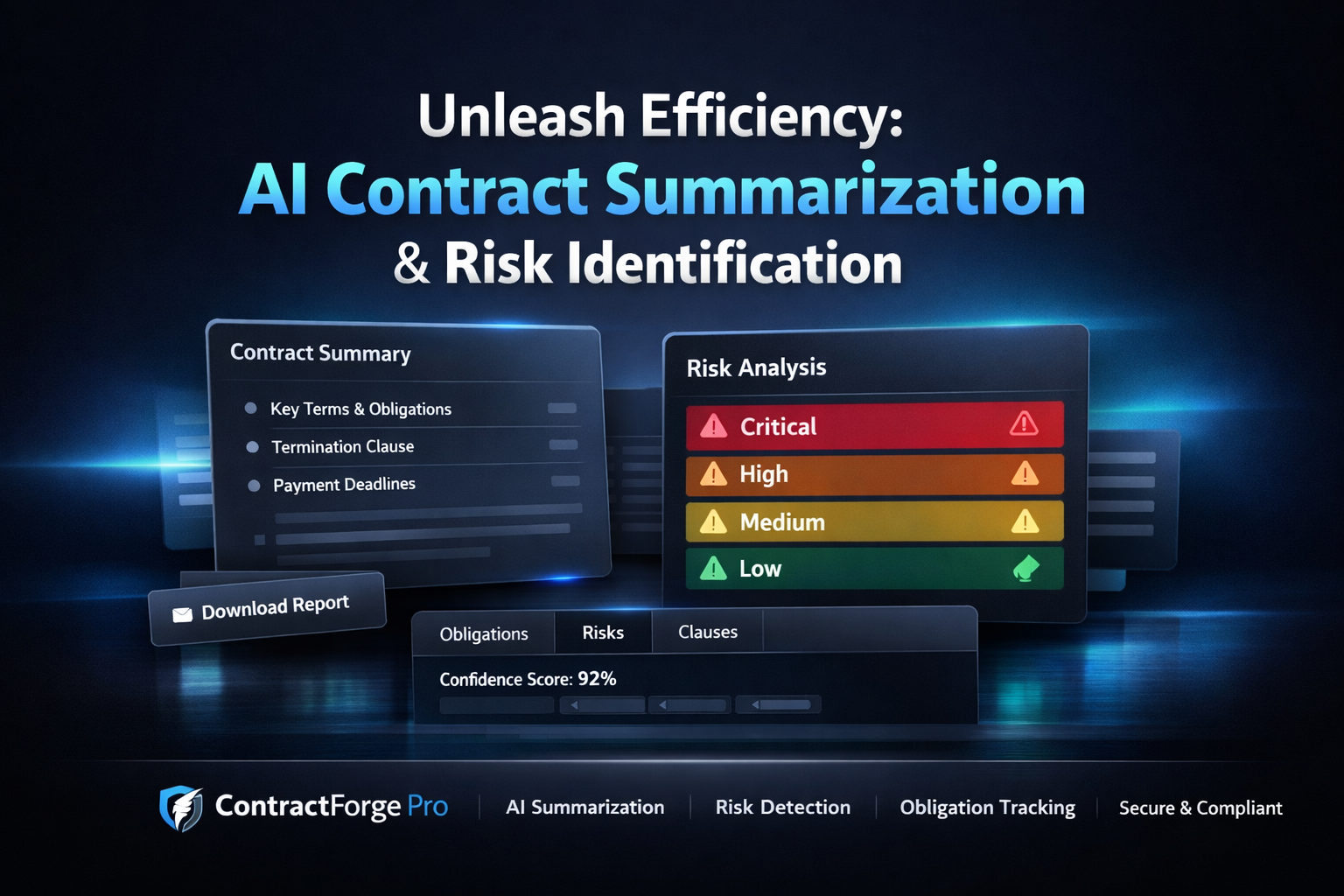
Platforms like ContractForge Pro classify risks into categories such as Critical, High, Medium, and Low. This tiered approach helps legal professionals prioritize their attention and allocate resources effectively. A "Critical" risk might indicate a direct breach of regulation or an unacceptable liability, while a "Low" risk might be a minor drafting inconsistency. This granular insight transforms risk management from a reactive firefighting exercise into a proactive, strategic advantage.
How AI Uncovers Hidden Dangers
AI systems are trained on vast repositories of legal agreements, industry benchmarks, and regulatory frameworks. They can identify:
- Deviations from Standard Language: Flagging clauses that differ significantly from templates or common industry practice.
- Missing Clauses: Alerting to the absence of essential provisions, such as indemnification, force majeure, or termination clauses, particularly crucial for Canadian legal contexts.
- Conflicting Terms: Highlighting contradictory statements or obligations within the same document or across related agreements.
- Regulatory Compliance Gaps: Identifying areas where a contract may not align with specific laws, like PIPEDA in Canada, or industry-specific regulations.
- Unfavorable Terms: Pointing out clauses that disproportionately favor one party or impose undue burdens.
By providing detailed explanations and often linking back to the source text, AI not only identifies the risk but also empowers the legal professional to understand why it is a risk.
Categorizing Risk for Actionable Insights
The assignment of severity levels is not arbitrary; it's based on pre-defined rules, machine learning models, and potentially even user-defined parameters.
- Critical/High: These risks demand immediate attention, often requiring negotiation, amendment, or legal counsel before proceeding. Examples might include unlimited liability clauses or non-compliance with critical data privacy laws like PIPEDA.
- Medium: These risks might warrant further investigation or consideration but may not halt a transaction. They could involve less favorable payment terms or minor deviations from standard practice.
- Low: These are often minor issues, such as stylistic inconsistencies or small ambiguities, which can be addressed during routine review or accepted.
This intelligent categorization ensures that legal teams can efficiently triage their workload, focusing their expertise where it matters most, and providing clear, actionable intelligence to their clients or business stakeholders.
How AI Transforms Your Risk Management Strategy
Integrating AI into your legal operations fundamentally reshapes your approach to risk management. It moves beyond simply identifying problems; it empowers legal teams to mitigate issues proactively, enhance compliance, and make more informed strategic decisions. The shift from manual, often superficial, review to AI-powered, in-depth analysis provides a robust defense against legal and financial exposures.
One of the primary ways AI transforms strategy is by providing comprehensive data. Instead of relying on a human reviewer's individual experience, AI can apply a consistent, objective lens across all contracts, reducing the variability of risk assessment. This leads to a more standardized and reliable risk profile for your organization. For an in-depth look at identifying potential pitfalls, read our article, "Spot the Unseen: Unusual Clause Detection & Industry Benchmarks."
Enhancing Compliance and Governance
For businesses operating in Canada, compliance with regulations like PIPEDA is non-negotiable. AI-powered platforms can be configured to specifically flag clauses that relate to data privacy, consent, and data handling, ensuring that contracts align with legal requirements. This proactive compliance checking helps avoid costly fines, reputational damage, and legal disputes.
Reducing Human Error and Oversight
Even the most experienced legal professionals can overlook critical details when faced with tight deadlines and vast document volumes. AI acts as an invaluable second set of eyes, tirelessly scrutinizing every word and clause. This significantly reduces the likelihood of human error, ensuring that no significant risk or obligation slips through the cracks. The confidence scores provided by AI add another layer of trustworthiness, indicating the system's certainty in its findings and often linking to source citations for verification.
Empowering Strategic Decision-Making
With rapid contract risk identification, legal and business leaders gain a clearer, real-time understanding of their contractual obligations and exposures. This insight supports better decision-making in various scenarios:
- Negotiations: Armed with a detailed risk profile, legal teams can negotiate more effectively, seeking to amend or remove unfavorable terms.
- Mergers & Acquisitions: During M&A due diligence, AI can quickly assess the target company's contractual liabilities, providing a clear picture of potential post-acquisition risks.
- Partnerships & Ventures: Understanding the risk landscape of new collaborations helps in structuring agreements that protect the organization's interests.
By transforming raw data into actionable intelligence, AI moves legal teams from being reactive legal custodians to proactive strategic partners within the business.
Beyond Summarization & Risk: The Power of AI Legal Intelligence
While AI contract summarization and risk identification are powerful on their own, their true potential is unlocked when integrated into a comprehensive AI-powered legal intelligence platform. ContractForge Pro, for example, extends its capabilities far beyond these core functions to offer a holistic solution for contract management, making it an indispensable tool for legal professionals in Canada.
Such platforms transform the entire contract lifecycle, from initial drafting and review to ongoing management and compliance. By consolidating various functionalities into a single, intuitive interface, AI intelligence streamlines processes that traditionally required disparate tools and manual oversight.
Streamlined Obligation and Deadline Tracking
Beyond simply identifying risks, AI can also intelligently extract and track critical obligations and deadlines embedded within contracts. This ensures that no commitment is missed, whether it's a renewal date, a reporting obligation, or a payment milestone. This proactive management significantly reduces the risk of non-compliance or missed opportunities. To learn more about mastering your commitments, explore "Master Your Commitments: Obligation & Deadline Tracking with AI."
Enhanced Collaboration and Version Control
Modern legal work is rarely a solitary endeavor. AI platforms often incorporate robust team collaboration tools, allowing multiple stakeholders to review, comment on, and approve contracts within a secure environment. Coupled with advanced contract versioning capabilities, every change is tracked, ensuring that legal teams always work with the most current version of a document and maintain a clear audit trail. This is crucial for maintaining integrity and accountability. Discover how to foster efficiency with "Seamless Collaboration & Versioning for Legal Teams."
Industry Standard Comparisons and Unusual Clause Detection
Sophisticated AI can compare your contracts against industry benchmarks and detect unusual clauses that deviate from typical market practice. This capability is invaluable during negotiations, allowing legal teams to advocate for terms that are fair and customary. Unusual clause detection helps flag potentially problematic or overly one-sided provisions, providing a competitive edge.
Multi-Language Support and Secure Data Handling
For global or multi-national operations, multi-language support (EN/FR/ES/DE) is a vital feature, enabling seamless review of international agreements. Crucially, platforms like ContractForge Pro prioritize data security, ensuring PIPEDA compliance and utilizing end-to-end encryption. This guarantees that sensitive legal data remains protected, upholding client confidentiality and regulatory requirements. This comprehensive approach underscores why a platform tailored for "ContractForge Pro: The Future of AI Contract Analysis for Canadian Legal Teams" is essential for modern legal practices.
FAQ Section
Q1: Is AI contract summarization truly accurate for complex legal documents?
A1: Yes, modern AI models are trained on vast legal datasets and use advanced natural language processing (NLP) to understand context and legal jargon. While always recommended for human review, AI summaries provide highly accurate, concise overviews of even the most complex legal documents, highlighting key terms and clauses reliably.
Q2: How does AI identify risk with severity levels?
A2: AI platforms analyze contract language against established legal precedents, industry benchmarks, regulatory requirements (like PIPEDA), and predefined risk categories. They identify deviations, missing clauses, or unfavorable terms and classify them into severity levels (Critical, High, Medium, Low) based on the potential impact and likelihood of an adverse outcome.
Q3: Can AI replace human lawyers for contract review?
A3: No, AI is a powerful tool designed to augment, not replace, legal professionals. It automates repetitive tasks like summarization and initial risk identification, freeing up lawyers to focus on complex legal analysis, strategic advice, negotiation, and client relations, where human judgment is irreplaceable.
Q4: How secure is my data when using an AI contract platform?
A4: Reputable AI legal intelligence platforms, like ContractForge Pro, prioritize data security. They employ end-to-end encryption, adhere to stringent data protection regulations such as PIPEDA for Canadian users, and implement robust access controls to ensure the confidentiality and integrity of your sensitive legal documents.
Q5: What types of contracts can AI summarize and analyze?
A5: AI can effectively summarize and analyze a wide range of contract types, including but not limited to, sales agreements, leases, employment contracts, non-disclosure agreements (NDAs), service agreements, merger and acquisition documents, and more. Its capabilities extend across various industries and legal domains.
Conclusion
The legal profession stands at the cusp of a technological revolution, and AI contract summarization and risk identification are at its forefront. By harnessing the power of artificial intelligence, legal teams can transcend the limitations of traditional, manual review processes, achieving unparalleled levels of efficiency and accuracy. From instantly distilling the essence of complex agreements to proactively identifying critical risks with nuanced severity levels, AI transforms how legal work is done.
For Canadian legal professionals and businesses, adopting these AI-powered solutions means not only saving valuable time and resources but also significantly enhancing compliance, reducing potential liabilities, and empowering more strategic decision-making. Platforms like ContractForge Pro are designed to integrate seamlessly into your workflow, providing the legal intelligence you need to thrive in a demanding environment. Don't let outdated processes hold you back. Explore the future of legal intelligence and see how AI can revolutionize your practice.
Ready to transform your legal operations? Discover ContractForge Pro's Pricing Plans and start your Free Trial today!