Blog Article
Beyond Keywords: Understanding True AI Contract Intelligence in 2026
Discover what true AI contract intelligence means in 2026, moving beyond simple keyword searches to contextual understanding and deep legal insights with platforms like ContractForge Pro.
Beyond Keywords: Understanding True AI Contract Intelligence in 2026
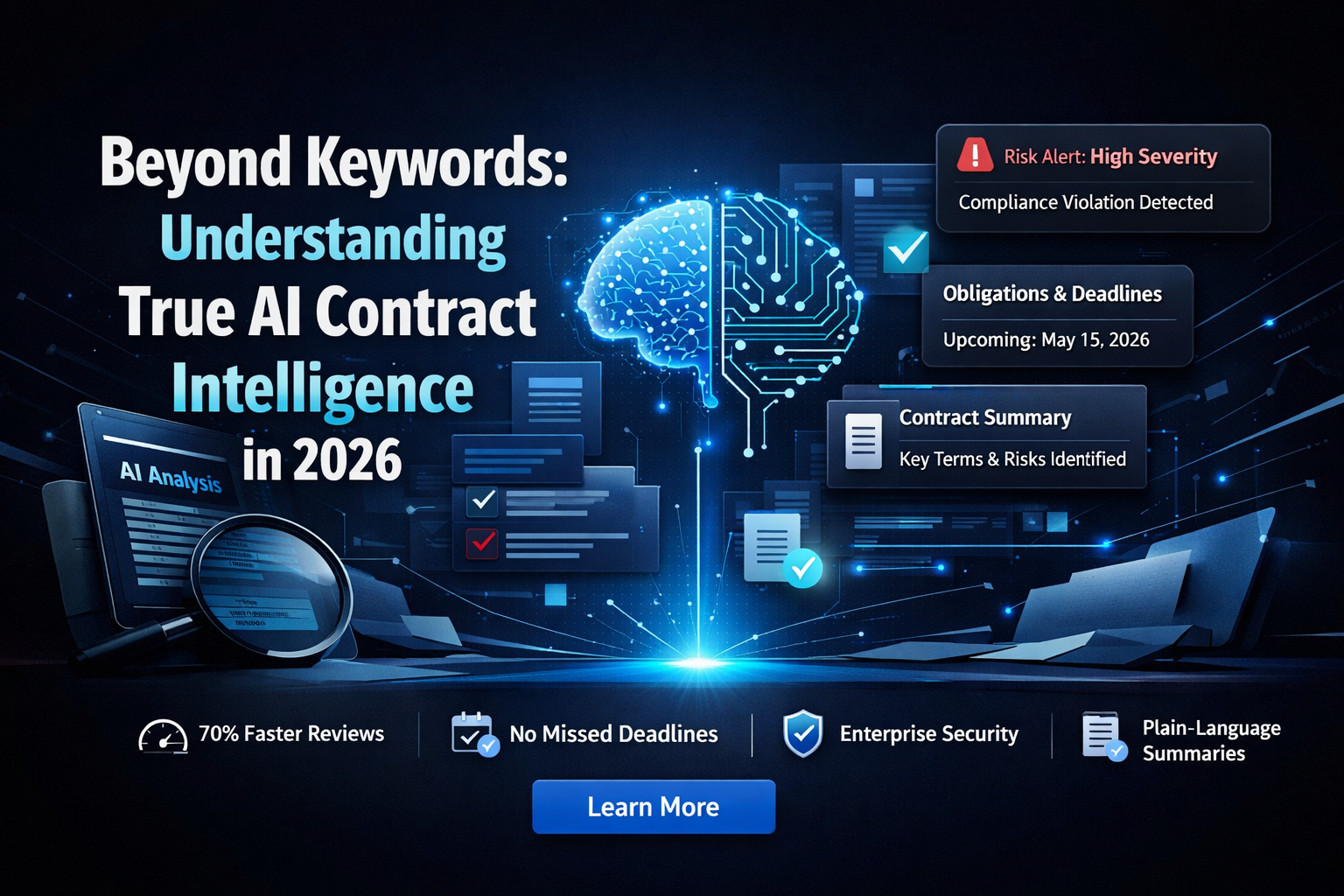
In 2026, the legal landscape demands more than just traditional keyword searches for contract analysis. Legal professionals are constantly battling complex documents, tight deadlines, and the inherent risks of manual review. This is where a true AI contract intelligence platform becomes indispensable, fundamentally changing how contracts are understood and managed. It's about moving past superficial analysis to unlock deep, contextual insights.
The evolution of artificial intelligence has propelled legal technology into an era where machines don't just identify terms; they interpret them, understand their implications, and even predict potential risks. This article delves into what constitutes genuine AI contract intelligence, exploring the sophisticated legal AI capabilities that power platforms like ContractForge Pro. We'll uncover how machine learning contracts are processed, interpreted, and transformed into actionable intelligence, defining the very future of legal tech.
For years, legal teams have grappled with the limitations of basic search functions, often leading to missed clauses, overlooked obligations, and significant operational inefficiencies. If you're Tired of Manual Contract Headaches? Discover the ContractForge Pro AI Solution that moves beyond these archaic methods. We'll demonstrate how advanced AI offers an unprecedented level of precision and speed, equipping legal teams with the tools needed to thrive in today's fast-paced corporate environment.
Defining AI Contract Intelligence: More Than Just Search
When we talk about "AI contract intelligence" in 2026, we're not simply referring to a system that finds specific words or phrases. While keyword search has its place, it's a blunt instrument in the nuanced world of legal documents. True AI contract intelligence transcends this by understanding context, intent, and legal implications, providing a level of analysis that mimics, and often surpasses, human capabilities in terms of speed and consistency.
At its core, genuine AI contract intelligence uses Natural Language Processing (NLP), machine learning, and deep learning models to perform semantic analysis. This means the AI doesn't just register that the word "liability" appears; it understands how liability is assigned, under what conditions, and to whom. It can discern the difference between "party shall indemnify" and "party may indemnify," recognizing the subtle but crucial legal distinctions that determine risk and obligation. This deep contextual comprehension is what sets an advanced AI contract intelligence platform apart from basic text search tools.
From Data Points to Legal Insights
Traditional methods treat contracts as mere data points. AI contract intelligence transforms them into sources of dynamic, actionable insights. By processing vast amounts of legal text, the AI identifies relationships between clauses, recognizes patterns that signify risk, and extracts critical data points like dates, parties, and obligations with high accuracy. This is not just data extraction; it's data interpretation that provides a comprehensive understanding of the entire contractual landscape.
The Role of Semantic Understanding
Semantic understanding is the cornerstone of advanced legal AI capabilities. It allows the AI to grasp the meaning and relationships of words and phrases within a legal document, even when the language varies. For instance, whether a contract uses "termination clause," "exit provision," or "right to cancel," a truly intelligent system understands that these refer to similar concepts. This semantic depth ensures that no critical information is missed, regardless of stylistic variations or complex legal jargon, making for a much more robust and reliable review process.
How AI Learns and Interprets Complex Legal Language
The ability of an AI contract intelligence platform to learn and interpret complex legal language is a testament to sophisticated machine learning contracts and deep learning algorithms. These systems are not pre-programmed with every possible legal scenario; instead, they are trained on massive datasets of legal documents, enabling them to recognize patterns, adapt to new information, and make increasingly accurate predictions and analyses over time.
Think of it like a highly diligent legal intern who has read millions of contracts and learned from expert annotations. The AI processes these documents, identifying contractual elements, legal concepts, and relationships. It uses advanced NLP to dissect sentences, understand the roles of different entities (parties, dates, values), and pinpoint the exact obligations and risks. This iterative learning process continuously refines the AI's understanding, allowing it to navigate the ambiguities and specificities of legal drafting with remarkable proficiency.
Training on Vast Legal Datasets
The foundation of any powerful legal AI lies in its training data. Platforms like ContractForge Pro leverage extensive, expertly curated datasets comprising millions of contracts from various industries and jurisdictions. This exposure to diverse legal language, contractual structures, and clause variations is crucial. It enables the AI to develop a nuanced understanding of legal terminology, common contractual patterns, and even industry-specific benchmarks, preparing it for the real-world complexity of your documents.
The Power of Contextual Analysis
Beyond simply recognizing terms, the AI excels at contextual analysis. It understands that the same word can have different meanings depending on its surrounding text. For example, "cure period" in one clause might relate to a breach, while in another, it could refer to a medical context (though less common in contracts, it illustrates the point). The AI identifies risks not just by the presence of certain keywords but by evaluating their context within the clause, the section, and the entire document. This includes identifying implicit risks, such as vague language or contradictory provisions, and assigning severity levels based on sophisticated risk models, providing valuable insights into potential liabilities. These are the kinds of features discussed in depth in "Unlocking Contract Insights: Smart Summarization & AI Risk Detection with ContractForge Pro".
The Strategic Advantages of Advanced Legal AI Platforms
Integrating an advanced AI contract intelligence platform into legal operations brings a cascade of strategic advantages, fundamentally redefining the future of legal tech. For legal professionals, general counsel, law firms, and corporate legal teams, the benefits extend far beyond mere efficiency gains; they encompass enhanced accuracy, proactive risk management, and the ability to drive strategic decision-making.
One of the most immediate impacts is the dramatic reduction in contract review time. Manual processes are notoriously slow and prone to human error, often leading to bottlenecks and missed deadlines. AI platforms can review documents in minutes, delivering comprehensive analyses that would take human lawyers hours or even days. This frees up valuable legal talent to focus on high-value strategic work, client consultation, and complex negotiations, rather than tedious document review. For an in-depth look at how this transformation plays out, consider exploring "Transform Your Practice: How ContractForge Pro Empowers Legal Professionals & Law Firms."
Enhanced Efficiency and Accuracy
The blend of speed and precision offered by AI is unparalleled. By automating the identification of critical clauses, obligations, and potential risks, AI minimizes human oversight and inconsistency. This ensures a higher level of accuracy across all contracts, reducing the likelihood of costly errors, non-compliance, and disputes down the line. Furthermore, features like obligation and deadline tracking ensure that no commitment is ever overlooked, systematically improving operational efficiency.
Proactive Risk Management
True AI contract intelligence is not just about identifying risks; it's about anticipating them. By analyzing contracts against a vast database and industry benchmarks, the AI can flag unusual clauses, highlight deviations from standard practice, and even identify subtle language that could lead to future legal exposure. This proactive approach to risk management empowers legal teams to mitigate potential issues before they escalate, safeguarding organizational interests and financial stability.
Empowering Strategic Legal Decisions
With granular insights at their fingertips, legal professionals can move from reactive problem-solving to proactive, strategic counsel. AI-generated summaries, risk assessments, and obligation dashboards provide a clear, concise overview of contractual commitments. This empowers legal teams to make data-driven decisions, negotiate more effectively, and advise business stakeholders with greater confidence and foresight. It transforms the legal department from a cost center into a strategic partner that actively drives business value.
FAQ Section
Q: What's the difference between AI contract intelligence and basic contract review software?
A: Basic software typically relies on keyword searches or simple rule-based logic. AI contract intelligence, however, uses machine learning and NLP to understand the context and meaning of legal language, identify subtle risks, and extract complex relationships, providing much deeper and more nuanced insights.
Q: How does AI ensure accuracy with legal nuances?
A: AI systems for contracts are trained on vast datasets of legal documents and often refined by legal experts. They use advanced NLP models to discern legal jargon, context-dependent meanings, and even the intent behind clauses, leading to highly accurate and legally sound analyses.
Q: Is my data secure with an AI contract intelligence platform?
A: Reputable AI platforms prioritize enterprise-grade security. For instance, ContractForge Pro implements SOC 2 and GDPR compliance, ensuring that your sensitive legal data is protected with the highest industry standards for privacy and security.
Q: Can AI truly replace human legal expertise?
A: No, AI contract intelligence is designed to augment, not replace, human legal expertise. It automates time-consuming tasks like review and identification, allowing legal professionals to focus their critical thinking, judgment, and strategic skills on more complex and high-value legal work. It's a powerful tool that enhances human capabilities.
Conclusion
The journey from basic keyword searches to sophisticated AI contract intelligence marks a pivotal shift in the legal profession. As we move further into 2026, the demand for an AI contract intelligence platform that truly understands the intricacies of legal language is undeniable. This level of intelligence, driven by advanced machine learning contracts and deep legal AI capabilities, empowers legal professionals to reclaim valuable time, mitigate risks more effectively, and elevate their strategic contribution to their organizations.
Platforms like ContractForge Pro are at the forefront of this revolution, transforming arduous contract review into a streamlined, insightful, and proactive process. By delivering plain-language summaries, identifying risks with severity levels, and tracking crucial obligations, these tools are not just improving efficiency; they are fundamentally reshaping the future of legal tech. Embracing this advanced intelligence is no longer optional—it's essential for any legal team aiming to achieve unparalleled accuracy, speed, and strategic advantage in today's dynamic legal environment.
Ready to revolutionize your contract analysis? Explore ContractForge Pro's features or view our pricing plans to see how true AI intelligence can empower your legal team.